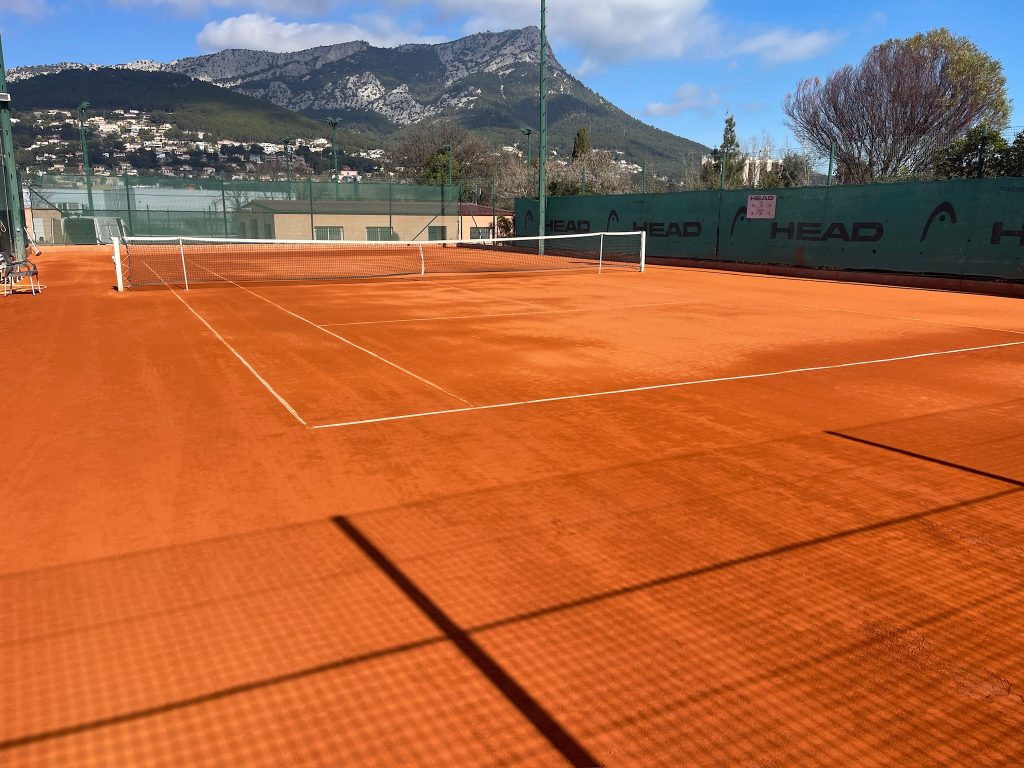
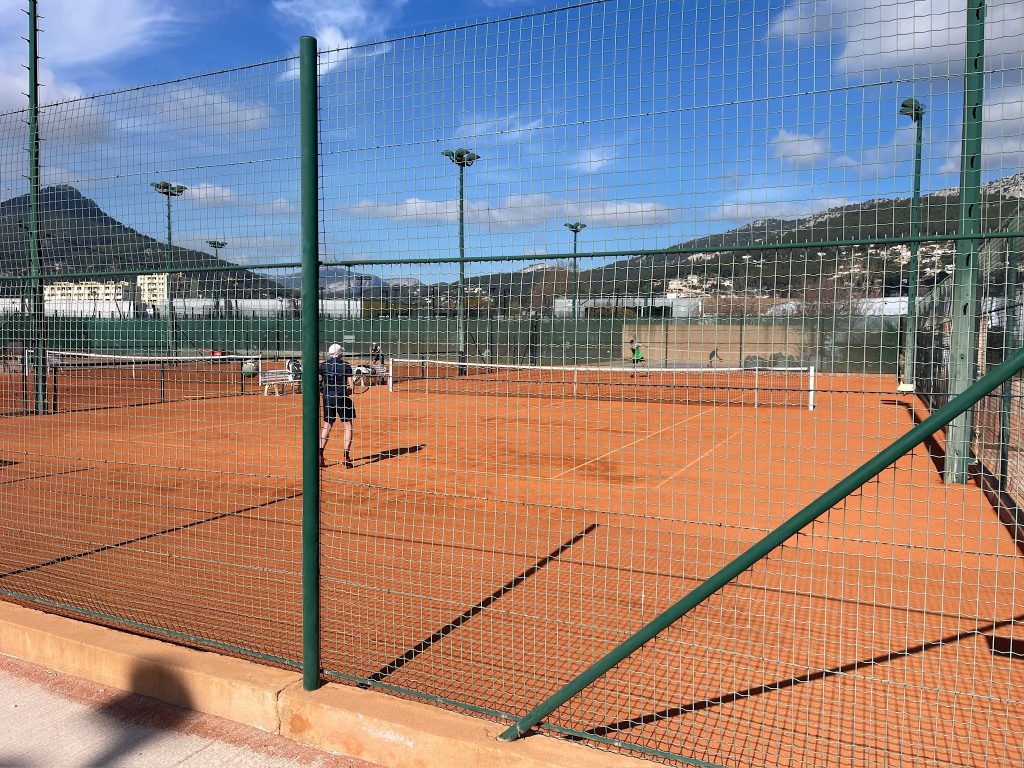
Artificial clay courts are built using a carpet or synthetic grass base combined with a crushed brick playing surface to reproduce playing characteristics equivalent to those of traditional clay courts. They are classified by the French Tennis Federation (FFT) within the same playing category as traditional clay courts.
The base.
Artificial clay courts require less maintenance than natural clay courts. They generally offer better drainage, greater resistance to frost, and do not require heavy annual refurbishment, making them more cost-effective to maintain. They are ideal for clubs wishing to preserve a “clay-court style” of play without the constraints of natural clay.
Artificial clay can be installed over an existing surface such as resin, porous concrete, asphalt, stabilized soil, or even a properly prepared natural ground.
Unlike traditional clay courts, which require a complete dedicated structure, this technology allows an existing court to be quickly converted into a clay-type court without major demolition work.
Before installation, the existing surface is restored and prepared: leveling, drainage correction, and resurfacing when necessary. The objective is to obtain a stable, uniform, and perfectly flat base.
The limestone layer ensures flexibility and playing comfort. Proper installation is essential, and during annual maintenance it must not mix with the clinker or pozzolana layers underneath.
The Surface System.
The system is installed using a methodology similar to that of synthetic turf installation: unrolling the surface rolls, joining the seams using bonding tapes, installing the technical infill, applying the finishing layers of crushed brick, watering, rolling, installing the court lines, brushing, and final leveling.
Each stage is carried out under strict flatness control to ensure a perfectly even playing surface.
The Infill.
The final crushed brick layer gives these courts playing qualities and performance equivalent to traditional clay courts.
User Maintenance.
As with natural clay courts, daily maintenance includes dragging the court surface and brushing the playing lines. To maintain proper moisture levels, the surface must also be watered depending on local conditions and the selected surface system.
Annual Maintenance.
Annual maintenance of artificial clay courts is less demanding than that of natural clay courts; however, simple maintenance principles must be followed to preserve the quality of the surface.
In spring, thorough brushing and the addition of a few bags of crushed brick are usually sufficient to restore optimal playing characteristics.
This operation must be carried out by an approved professional to ensure the playing quality is not compromised.